

Color Scheme and Corporate Identity
Selecting a color scheme is one of the most critical choices your business will ever make. Colors are powerful communication tools because they create different human responses. As a result, your brand’s colors will influence how consumers feel about you. Choosing the right corporate colors can highlight your strengths and help you attract the right customers. The wrong colors can ultimately have a negative effect.
Color schemes are much more calculated than you’d think. Researchers have spent decades studying color psychology and interpretation because it’s a valuable asset for nearly every field. The goal is to cultivate a strong, positive emotional connection with your customers through the use of color. To do this, your business must establish a color scheme that represents your brand.
Different colors speak to different consumers. Just like colors, your brand has a personality of its own. People like brands and products that align with their values and preferences. So, using the right colors can influence the right people. Defining your brand’s color scheme is a vital extension of your brand’s marketing plan. But what colors are right for your brand?
The Physiological Effects of Color
The same colors tend to provoke similar responses in different people. These are physiological responses—measurable yet temporary changes in the body. Color can influence things like blood pressure, heart rate, and even blinking frequency. Physiological responses have to do with primal instincts, especially for colors found in nature.
This is highly scientific and relates to nerve centers within the body. It’s the way our bodies naturally interpret things like danger and safety. For example, it’s how we know red is hot and blue is cold. It’s just a part of our human experience.

“Currency comes in a rainbow of colors. Every country holds its color preferences based on cultural norms within religion, government, currency, education, and other systems.”
The Psychological Effects of Color
On the other hand, psychological reactions are based on cultural associations. This is where things get tricky. Your feelings about colors are often rooted in your experiences. Let’s talk about the cultural significance of the color green. As Americans, we generally have a favorable view of the color green. For example, we relate it to wealth and nature. However, in Indonesia, green is a forbidden color. In China, green can symbolize infidelity. In South America, green usually symbolizes death. Color psychology is all relative.
Age also influences the way we interpret color. According to a study by the University of Kentucky, “Children up to age three tend to prefer bright, primary colors over pastels, and favor bright luminous colors such as red, orange, pink and yellow.” As a result, the color red is a favorite during early preschool years. As children grow older, their interest in cooler colors increases, and their preference for high-intensity colors decrease.
Most adults prefer blue and indicate a dislike for yellow. “Later in life, our color preferences may again change. Studies of people from ages 65 to 90 indicate they prefer bright colors to pale pastels. This may relate to the physical changes in the eye.” Although we often make cultural associations about color, our preferences may be less superficial. “A greater liking for the colors in shorter wavelengths such as blue and green than for colors of longer wavelengths such as red, orange, and yellow comes with maturity.”
Finding the Right Colors for Your Audience
Different colors evoke different emotions. Ideally, these evoked emotions align with your company’s goals. It’s all about leaving the right impression. Your company’s color scheme should cater to your audience to make sure you’re conveying the right message. First, you need to determine who your customers are.
- How old are your ideal customers?
- Do you want your brand to feel masculine, feminine, or neutral?
- What countries will your business serve?
- Is your brand youthful or mature?
- Is your product luxurious or affordable?
Your answers to these questions will give you an idea of your brand’s personality and how it relates to different colors. Of course, this is from an American perspective. If you’re serving international customers, we recommend researching a little deeper to find that country’s color preferences.
Color Schemes
Color undoubtedly impacts mood and behavior. Typically, the more complex a color is, the more multifaceted the emotional response is. This is something to consider when planning out your brand’s color scheme. Your industry and offerings should direct how simple or complex your color scheme is
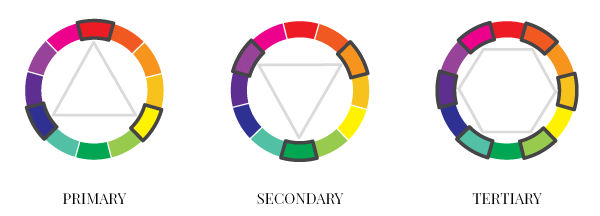
Color Theory Basics
Primary Colors: The three colors that make all other colors. They are red, yellow, and blue.
Secondary Colors: These colors are created by combining the primary colors. Secondary colors are orange, green, and purple.
Tertiary Colors: These colors are made by combining a primary color with a secondary color. Tertiary colors are the in-between colors. They’re the ones with fancy-sounding names—vermillion, amber, chartreuse, teal, violet, and magenta.
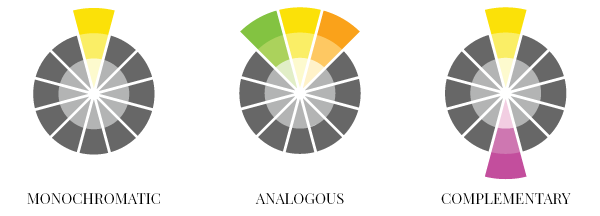
Basic Types of Color Schemes
Monochromatic: Palettes using a single hue
Analogous: Harmonizing colors from either the warm or cool spectrum
Complementary: Colors opposite on the color wheel
RED
Passion
Excitement
Attention
Rage
Heat
Danger
ORANGE
Playfulness
Friendliness
Vitality
Heat
Aggression
Distrust
YELLOW
Happiness
Optimism
Confidence
Caution
Decay
Sickness
GREEN
Nature
Stability
Growth
Jealousy
Disease
Guilt
TEAL
Refreshing
Intuition
Creativity
Premeditated
Emotional
Introversion
BLUE
Tranquility
Professionalism
Security
Melancholy
Formality
Depression
PURPLE
Royalty
Creativity
Luxury
Mystery
Tension
Sadness
PINK
Femininity
Youth
Innocence
Passiveness
Agitation
Immaturity
BROWN
Earthy
Old-Fashioned
Dirt
Isolation
Dullness
GRAY
Wisdom
Futuristic
Dampness
Boredom
Gloom
WHITE
Purity
Peace
Starkness
Cold
Sterility
BLACK
Sophistication
Edginess
Darkness
Mourning
Death
Accounting
- Blue appears in 55% of industry-leading logos
- Typical colors: blue, black, and white
- Rarely used colors: purple, yellow, brown, and pink
Agriculture
- Green appears in 60% of industry-leading logos
- Typical colors: green, red, yellow, and brown
- Rarely used colors: pink and purple
Healthcare
- Blue appears in 85% of industry-leading logos
- Typical colors: blue and white
- Rarely used colors: brown, pink, purple, and yellow
Legal Services
- White appears in 20% of industry-leading logos
- Typical colors: blue, red, black, gray, and white
- Rarely used colors: yellow, purple, brown, and pink
Marketing
- Blue appears in 27% of industry-leading logos
- Typical colors: blue, gray, black, white, and red
- Rarely used colors: pink and purple
Real Estate
- Blue appears in 68% of industry-leading logos
- Typical colors: blue, white, black, gray, red
- Rarely used colors: orange, purple, pink
Retail
- Red appears in 59% of industry-leading logos
- Typical colors: red, white, blue, black
- Rarely used colors: purple, brown, pink, gray
Technology
- Blue appears in 61% of industry-leading logos
- Typical colors: blue, white, black, red
- Rarely used colors: pink, brown, gray
Here are some easy ways to strengthen your brand’s association with its signature color:
- Color usage in your logo
- The main color used in advertisements
- Color-themed website design
- Storefronts branded with your signature color
- Staff uniforms


